
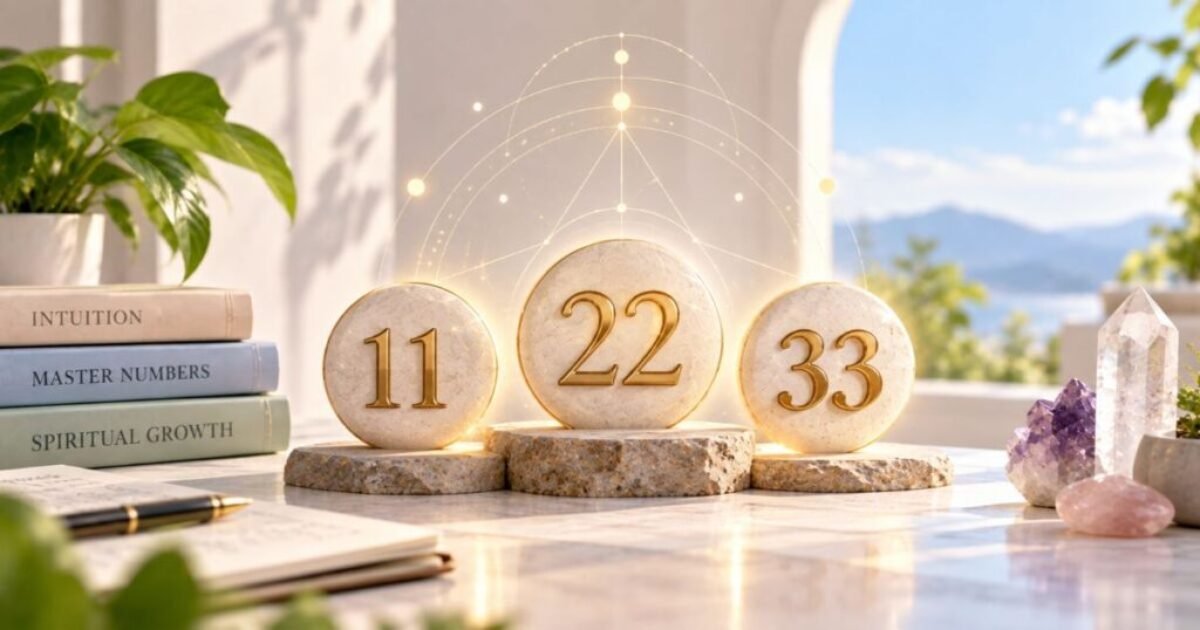
Master Numbers in Numerology Explained: 11, 22, 33 — 2026 Guide | Numerascope
Master numbers in numerology are 11, 22, and 33, three numbers that break the usual reduction rule. This guide covers why they’re treated differently, and what each one is traditionally said to mean.
|
Quick Answer
Master numbers in numerology are 11, 22, and 33, three numbers that are traditionally left unreduced rather than simplified to a single digit. Each is read as an intensified version of its root number (2, 4, or 6), carrying both greater potential and greater internal pressure.
Master numbers came up constantly while I was testing this site’s calculators, since I ran hundreds of test names and dates through them to check the reduction logic, and needed to be certain the exception was handled correctly every time. Getting master numbers in numerology right in the code mattered more than almost anything else in this build. This guide is the explanation I wish had been easier to find while doing that testing.
What Makes a Number a Master Number
In most numerology calculations, any total above 9 is reduced by adding its digits together until one digit remains. Master numbers in numerology are the exception: when a calculation lands on exactly 11, 22, or 33 at any point during that reduction, tradition holds that the number should be left as is rather than reduced further to 2, 4, or 6.
|
Try It Yourself
Check Your Own Numbers
Calculate your destiny number to see if it lands on a master number, the calculator flags it automatically. |
Why Master Numbers Are Treated Differently
The reasoning, as most numerology sources explain it, is that these three numbers carry an intensified version of their single-digit root, more potential, and traditionally, more internal pressure that comes with that potential. Understanding master numbers in numerology starts with this one idea: an 11 isn’t read as “better” than a 2, it’s read as a 2 with the volume turned up, in both its strengths and its challenges.
| 3
Master Numbers
|
11 22 33
The Set
|
0
Further Reduction
|
11, 22, and 33 Explained
| 11
The Intuitive
Rooted in the 2’s sensitivity, associated with heightened intuition and a pull toward inspiring others, alongside a tendency toward overwhelm. |
22
The Master Builder
Rooted in the 4’s discipline, associated with turning large visions into concrete results, alongside a risk of perfectionism. |
33
The Master Teacher
Rooted in the 6’s care, associated with guiding or healing others at scale, alongside a risk of self-neglect. |
These three cover the full set. Nothing above 33 is treated as a master number in this system, and nothing between the single digits and 11 is either, master numbers in numerology are specifically this trio, not a broader category.
Should You Reduce a Master Number Further?
No, this is the one case in Pythagorean numerology where the usual reduction rule is deliberately paused. If your calculation lands on 11, 22, or 33 partway through reducing a larger number, that’s your final result, not an intermediate step to keep simplifying. Both the destiny number calculator and the life path number calculator on this site apply this rule automatically, so you never have to remember it yourself.
Master numbers are the one part of this whole system where getting the code wrong would have been genuinely embarrassing.
It’s a small exception to an otherwise simple rule, reduce until one digit remains, except stop at 11, 22, or 33. I tested this specifically with names and dates designed to hit those three numbers before this site went live, because master numbers in numerology are exactly the kind of detail a rushed build gets wrong.
Summary
- Master numbers in numerology are 11, 22, and 33, nothing else qualifies, and that’s the full list.
- They’re left unreduced rather than simplified further, unlike every other total.
- Each is read as an intensified version of its root: 11 from 2, 22 from 4, 33 from 6.
- Master numbers can appear in either a destiny number or a life path number calculation.
- Having a master number isn’t read as better or worse, just more intense.
People Also Asked
What are the master numbers in numerology?
The master numbers in numerology are 11, 22, and 33. They’re the only totals above 9 that are traditionally left unreduced rather than simplified to a single digit.
Why is 11 a master number and not 10?
10 reduces normally to 1, since it doesn’t match the specific set of 11, 22, or 33 that numerology tradition treats as exceptions. Master numbers in numerology are exactly those three, and only those three, get the master-number treatment.
Is having a master number rare?
Yes, mathematically fewer birth dates and names reduce to exactly 11, 22, or 33 than to an ordinary single digit, making them less common results.
Frequently Asked Questions
Are master numbers rarer than regular numbers?
Yes, mathematically fewer birth dates and names reduce to exactly 11, 22, or 33 than to an ordinary single digit, which is part of why master numbers in numerology carry extra weight in a reading.
Is having a master number considered good or bad?
Neither, it’s read as more intense in both potential and challenge, not as inherently positive or negative. That’s true across every version of master numbers in numerology you’ll find.
Can I have more than one master number?
Yes, it’s entirely possible for both your life path and destiny number to independently land on a master number.
What’s the difference between 11 and 22?
11 is rooted in the number 2 and associated with intuition and sensitivity. 22 is rooted in the number 4 and associated with disciplined, large-scale building, both are part of the same small set of master numbers in numerology.
Do master numbers appear in life path or destiny numbers only?
Both. Master numbers in numerology can show up in any calculation that reduces digits, life path, destiny, compatibility, or lucky number, on this site.
How do I know if my number is a master number?
Both calculators on this site flag it automatically, look for the “Master Number” label next to your result on the destiny number or life path calculator.
Explore More on Numerascope
Sources referenced in this guide: Britannica: Pythagoras, Merriam-Webster: Numerology.
Master numbers in numerology are a small but important exception to the standard rule, and once you understand master numbers in numerology, a result of 11, 22, or 33 on either calculator on this site will make immediate sense instead of looking like an error.


